Life Trockenrasen: Xerolenta obvia


Xerolenta obvia
Dry open landscapes are an uncommon habitat for snails. Nevertheless, the species Xerolenta obvia can be found in these habitats, as it thrives in sunny and warm conditions.
In early spring, the first juvenile snails emerge from their winter dormancy. They feed on dry plant matter, grow, and become sexually mature. The shell reaches a diameter of up to 20 millimetres and typically has five to six flat whorls in the adult stage. Its base colour is white with dark brown to black edges. The snail itself is yellowish-brown with dark tentacles.
Summer Aestivation
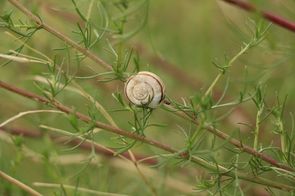
When the summer becomes too hot, Xerolenta obvia enters another resting phase to protect itself from dehydration. The snail climbs up a plant stem, seals its shell, and falls into a state of aestivation. It can survive for weeks without moisture or food in this state. With an abundant food supply, multiple snails often climb a single stem, creating the appearance of a mass occurrence. Its pale shell coloration is well-adapted to its dry grassland habitat, as it reflects sunlight. As temperatures drop again in autumn, mating takes place. The females lay their eggs, which usually hatch in November, while the older snails die off.
Distribution
As its German name “Östliche Heideschnecke” (Eastern Heath Snail) suggests, the snail is primarily found in Eastern Europe. Its western range extends into Germany. It is closely related to the heath snail, which is more common in Great Britain and France.
Threats
Although Xerolenta obvia is not yet considered endangered in Brandenburg, its population continues to decline. As dry grasslands disappear, so do their snails, as they struggle to leave the habitats they are adapted to. Only their calcareous shells remain in the soil for decades.


Das Projekt LIFE Trockenrasen
Die Stiftung NaturSchutzFonds Brandenburg realisiert gemeinsam mit dem Botanischen Garten der Universität Potsdam und der NABU-Stiftung Nationales Naturerbe von 2019 bis 2026 das Projekt "LIFE Trockenrasen". Mit dem Projekt werden wertvolle Trockenlebensräume im Land Brandenburg geschützt, erhalten und wiederhergestellt.
Ansprechpartnerin:
Janine Ruffer (Projektleitung)
E-Mail schreiben