Life Trockenrasen: Common Swallowtail


Common swallowtail
The common swallowtail is a striking butterfly known for its elegant shape and colourful appearance. It is widespread in Europe, North Africa, Asia, and North America. In Germany, it is one of the largest butterflies. The common swallowtail is mostly found in sunny and open habitats. It lives in flower-rich meadows and dry grasslands, but it can also be found in gardens.
Characteristics
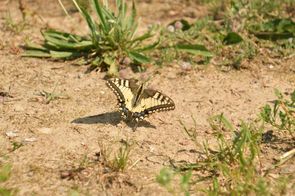
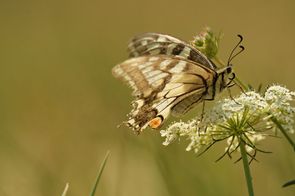
The swallowtail is distinguished by its characteristic tail-like extension on the hindwings. These resemble the tail feathers of a swallow, which is how it got its name. The wingspan of this butterfly can be up to eight centimetres. The topside of its wings is light yellow, with black wing veins and spots. The underside, on the other hand, is much paler, with similar black markings. Especially striking are the hindwings, which have a bluish dusted band with red eyespots on the wing margin. The swallowtail also has hairy forelegs, which serve as cleaning brushes. The second butterfly generation of the year can be identified by its strong colours and the yellow-dusted black markings compared to the first generation.
Mating
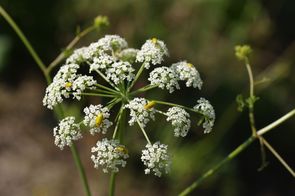
When the swallowtail seeks a mate, a special event occurs known as "hilltopping." In the spring, the males repeatedly sail to higher locations such as mountain peaks, hills, or towers, hoping to encounter a female there. Mountain parsley is a favoured by larvae, a plant which is typical of dry grassland communities and can be found in many areas of the LIFE Trockenrasen project. However, larvae also enjoy eating carrot, fennel, and dill, which is why the butterfly is commonly found in gardens. The larvae of the swallowtail have a striking coloration: they are green with black stripes and have distinctive orange-red spots. If the caterpillar feels threatened, it extends its orange-coloured neck fork, which secretes a substance to repel enemies, such as ants. The pupa of the swallowtail is greenish brown in colour, and after 12 – 19 days, a new colourful swallowtail emerges.
Threats
The swallowtail is ecologically greatly significant. As a pollinator, it plays an important role in the fertilization of flowers, thus contributing to the preservation of plant diversity. Additionally, it serves as an indicator of environmental health, as it is sensitive to changes in its habitat. In Brandenburg, the swallowtail is listed as near threatened on the Red List and is unfortunately becoming increasingly rare.

Das Projekt LIFE Trockenrasen
Die Stiftung NaturSchutzFonds Brandenburg realisiert gemeinsam mit dem Botanischen Garten der Universität Potsdam und der NABU-Stiftung Nationales Naturerbe von 2019 bis 2026 das Projekt "LIFE Trockenrasen". Mit dem Projekt werden wertvolle Trockenlebensräume im Land Brandenburg geschützt, erhalten und wiederhergestellt.
Ansprechpartnerin:
Janine Ruffer (Projektleitung)
E-Mail schreiben