Life Trockenrasen: Brown Hare


Brown hare
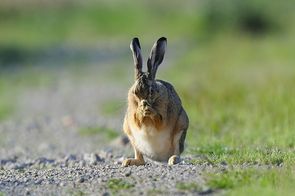
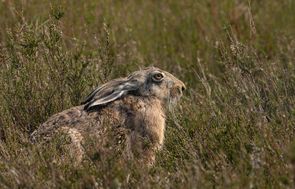
The brown hare is one of the few species that can also be observed with some luck on dry grasslands during the winter months. It can still find some grasses and twigs to nibble on and mating season begins as early as January.
Distribution - From Europe to America to Australia
As the scientific name suggests, the brown hare originally comes from Europe, where populations span from Spain to Russia. However, the brown hare has been introduced to North and South America, as well as Australia and New Zealand. Originally occurring in the steppes brown hares prefer open agricultural landscapes such as fields, meadows, and croplands. Occasionally, they also inhabit forests or even marshland.
Long Ears – Appearance and Lifestyle
Contrary to popular belief, hares are not rodents but belong to the order Lagomorpha (hares and rabbits). The brown hare is one of the largest members of this order in Europe, reaching up to five kilograms in weight. Its ears can grow up to 14 cm long and allows the hare to detect even the faintest sounds. By day, the hare rests in its form—a shallow depression in the ground. When threatened, it flattens itself against the ground and freezes, using its reddish-brown coat for perfect camouflage. It only flees at the very last moment, relying on its powerful hind legs to reach speeds of up to 70 km/h. As a solitary animal, the brown hare mainly forages at night and during twilight. The brown hare is a herbivore and feeds on grasses, herbs, field crops, and roots. In winter, it also consumes bark, twigs, and buds. Hares only meet during the mating season, which lasts from January to October in periodic intervals. In spring, you might spot their courtship rituals on dry grasslands or fields. After initial approaches, males and females chase one another and even engage in boxing matches. The female selects the strongest male, mating multiple times in a short period. She is capable of superfetation—becoming pregnant again while already carrying embryos. On average, a female gives birth three to four times a year, with litters of two to five young.
Threats
The intensification of agriculture, along with the use of pesticides, fertilizers, and heavy machinery, has led to a steady decline in hare populations over the years. Additionally, an increasing number of predators such as foxes and members of the crow family, as well as prolonged rainy periods, pose challenges for young hares. The conversion of fallow land, hedgerows, and field margins into farmland has deprived hares of shelter and feeding grounds, making survival even harder. Restoring and maintaining dry grasslands with their open structures would greatly benefit the European hare.

Das Projekt LIFE Trockenrasen
Die Stiftung NaturSchutzFonds Brandenburg realisiert gemeinsam mit dem Botanischen Garten der Universität Potsdam und der NABU-Stiftung Nationales Naturerbe von 2019 bis 2026 das Projekt "LIFE Trockenrasen". Mit dem Projekt werden wertvolle Trockenlebensräume im Land Brandenburg geschützt, erhalten und wiederhergestellt.
Ansprechpartnerin:
Janine Ruffer (Projektleitung)
E-Mail schreiben