Life Trockenrasen: Blue-winged Grasshopper


Blue-winged grashopper
In the winter months, the dry grassland seems empty and deserted, with no buzzing, humming, or chirping to be heard. Many dry grassland animals have migrated south, are hibernating, or have died before the onset of winter. The later applies to the Blue-winged Grasshopper; only its offspring survive the winter in the barren soil of the dry grassland.
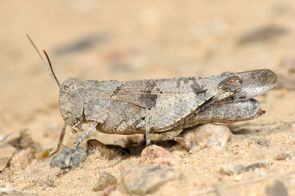
It is not until late spring, when temperatures are significantly warmer, that nymphs (larvae) hatch from the eggs, which develop into fully grown grasshoppers after four to five molts. With each molt, the grasshopper increasingly blends in with its surroundings in terms of colour. This process is called homochromy. As a result, the animals appear highly variable, ranging from reddish-brown and grey to nearly black or white, depending on the area.
Camouflage is Everything
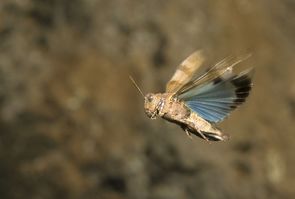
The best time to observe the Blue-winged Grasshopper is late summer. However, even then, it is difficult to spot, as when it sits on the ground, it is almost invisible. Its grayish-brown colour with black spots allows it to blend into its surroundings perfectly. This protects the grasshopper from predators. If in danger, it spreads its blue-coloured hindwings while jumping and then folds them up just before landing. This confuses its attackers.
Habitat
As the German name "Ödlandschrecke" (barren land grasshopper) suggests, this species thrives in barren, sandy dry grasslands with low vegetation. Here, it predominantly moves by walking, and will climb over small obstacles if necessary, although it does not climb plant stems. Its main food sources are grasses and other plants.
Mating Behaviour
During the mating season, unlike other grasshopper species, the Blue-winged Grasshopper does not display any courtship rituals, and the males do not produce chirping sounds. After mating, the female digs a hole in the sand and lays about eight egg pods, each containing 14 eggs. Now the cycle begins anew...
Das Projekt LIFE Trockenrasen
Die Stiftung NaturSchutzFonds Brandenburg realisiert gemeinsam mit dem Botanischen Garten der Universität Potsdam und der NABU-Stiftung Nationales Naturerbe von 2019 bis 2026 das Projekt "LIFE Trockenrasen". Mit dem Projekt werden wertvolle Trockenlebensräume im Land Brandenburg geschützt, erhalten und wiederhergestellt.
Ansprechpartnerin:
Janine Ruffer (Projektleitung)
E-Mail schreiben