Life Trockenrasen: Anthophora bimaculata


Anthophora bimaculata
Anthophora bimaculata is found in Southern and Central Europe and is relatively rare in Germany. As the German name "Dünen-Pelzbiene" (Dune Furry Bee) suggests, it can be found on inland dunes, in sand pits, on sandy wastelands, or at forest edges and clearings. Many wild bee species, including Anthophora bimaculata, prefer dry grasslands over other habitats due to their plant diversity and the numerous nesting opportunities. This bee species can be observed flying from June to late August.
Characteristics
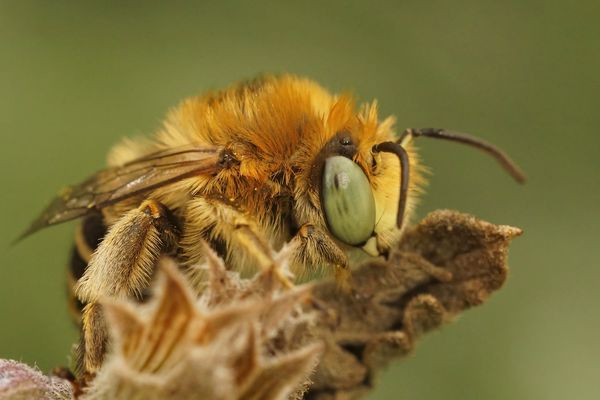
Anthophora bimaculata is distinguishable by its brownish fur and yellow-gray hair. Its large, green compound eyes are particularly striking. The bee can also be identified by its distinctively high-pitched flight sound.
Behaviour
Anthophora bimaculata is a solitary bee, meaning it does not live in social colonies with a queen. Instead, all females are capable of laying eggs, contributing directly to the species' survival. To reproduce, the female digs a nesting tunnel approximately five centimeters deep into the sand. Within the tunnel, she creates one or more brood cells, lays eggs, and then seals the cells.
For each brood cell, the female prepares a supply of pollen and nectar to feed the larvae. After hatching, the larvae consume the food supply, pupate, and eventually emerge as adult bees (Imago). Interestingly, the fully developed bee remains dormant over the winter, only emerging from its nest in the spring.
Diet
Anthophora bimaculata is not specialised in its search for food and gathers nectar and pollen from a variety of plants. This makes it an important pollinator. In dry grasslands, it commonly visits plants like Scabiosa canescens, spear thistle and spiked speedwell.
Threats
Like many other wild bee species, Anthophora bimaculata face the threat of habitat loss and a decline in suitable nesting sites. This is primarily due to the fact that sandy, dry soils are not considered to be economically profitable and are often reforested or exploited for building materials. Preserving and restoring dry grasslands with sandy areas and abundant floral diversity is therefore crucial for the long-term survival of Anthophora bimaculata.
Das Projekt LIFE Trockenrasen
Die Stiftung NaturSchutzFonds Brandenburg realisiert gemeinsam mit dem Botanischen Garten der Universität Potsdam und der NABU-Stiftung Nationales Naturerbe von 2019 bis 2026 das Projekt "LIFE Trockenrasen". Mit dem Projekt werden wertvolle Trockenlebensräume im Land Brandenburg geschützt, erhalten und wiederhergestellt.
Ansprechpartnerin:
Janine Ruffer (Projektleitung)
E-Mail schreiben